
Articles · Pricing and consignment
How to Price Jewelry So a 50/50 Consignment Split Still Pays You
How to price jewelry for consignment is the question that stops a lot of makers. I've watched people quit. Not because they lost the love. Because they couldn't figure out how to make it pay.
It happens most with stores. Which is a shame, because selling through stores is often the easiest way to get started when you don't have customers yet. Someone else has the foot traffic. You just need pieces in the case.
But the second a store asks for half, a lot of makers panic.
The 50/50 split isn't the problem
There's a myth that a 50/50 split means you're getting ripped off. In my experience, it's the opposite.
The more a store gets to keep, the faster they sell your work. Your pieces go up front. They talk about you. They reorder. Everybody wins. As long as your prices were built for it.
And that's where most makers get stuck.
When your prices only seem to work
Maybe your store owner friend lets you keep most of the money. Maybe your co op did. So your prices feel fine.
But they're only working because someone gave you a deal. The day a bigger store offers you a real 50/50 account, there's no room left. So you pass on it. Or you take it and quietly lose money on every piece.
The fix isn't avoiding the split. It's pricing so the split doesn't scare you.
Do the math before it leaves your bench
The easiest way to get there is to do the math up front. Before you send anything out, make sure each piece covers your expenses and leaves enough to make another one to sell.
Here's a simple example (example numbers):
- Materials and findings: $18
- Your time and overhead: $22
- Your profit: $20
- Your price to the store: $60
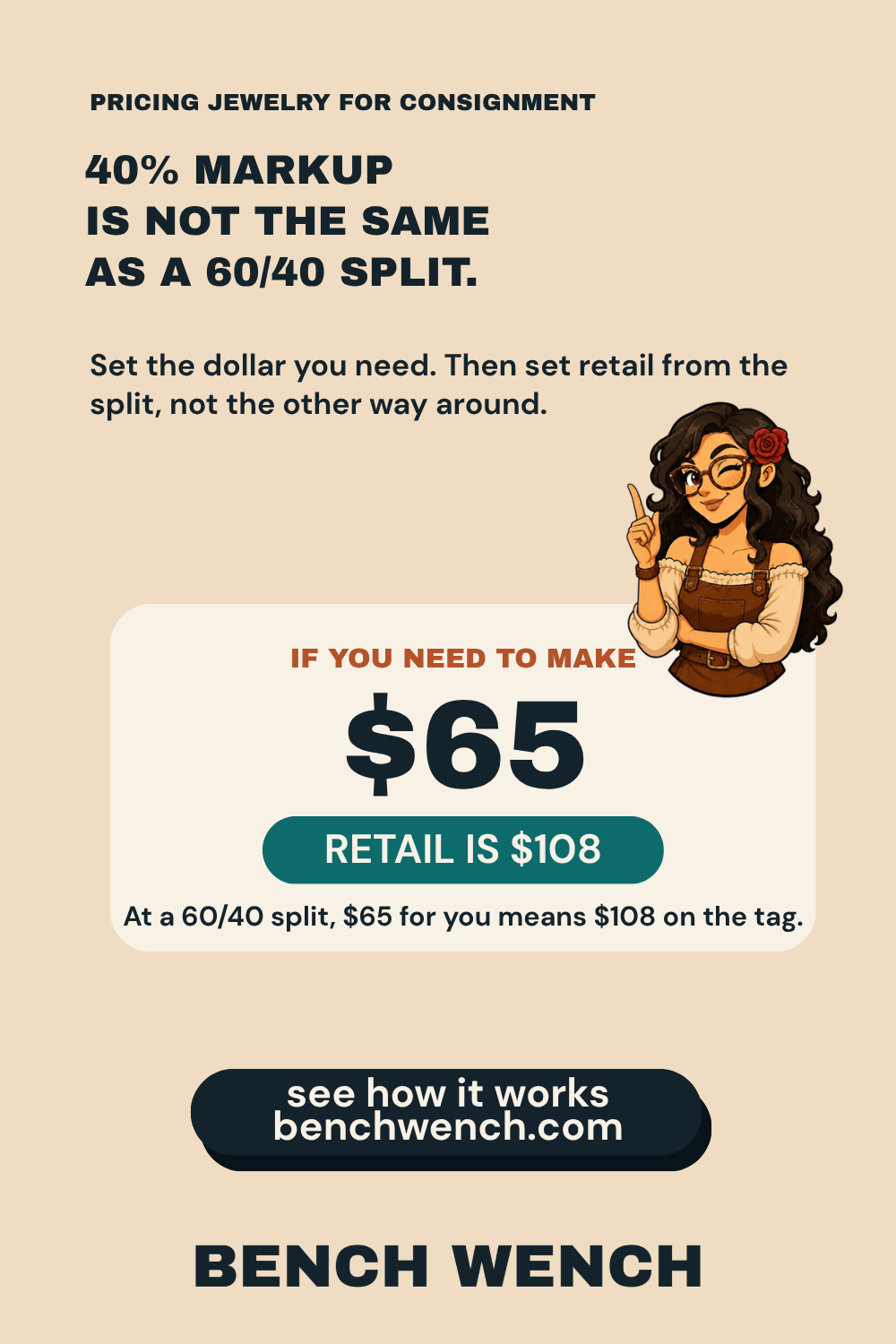
- Retail price on a 50/50 split: $120
If $120 makes you flinch, that's exactly why this matters.
This is the part BENCH WENCH does for you. Add the parts used and it shows your true cost to make, what you take home from each store split, and whether a piece is worth sending at all.
Why $5 isn't enough
Once you see the real numbers, the most common mistake jumps right out. Thinking a small amount like $5 per piece is enough profit.
It isn't. One slow month, one broken tool, one jump in the price of silver and it's gone. Because undercharging is the fastest way to burnout.
Keep one price everywhere
Should your consignment price be lower or higher than your own site or wholesale? No. Keep it the same.
You never want to undercut your stores. If a customer can find the same piece cheaper on your site, the store stops wanting your work. One price everywhere keeps your stores selling for you.
Price so you can keep going
Here's what it all comes down to. Price your work so you're profitable and you can keep doing this for longer. Selling too cheaply just isn't sustainable.
The makers who last aren't the ones with the lowest prices. They're the ones who did the math.
Want the math done for you? BENCH WENCH shows your true cost and profit on every piece, every store, every split. Join the beta at benchwench.com.